
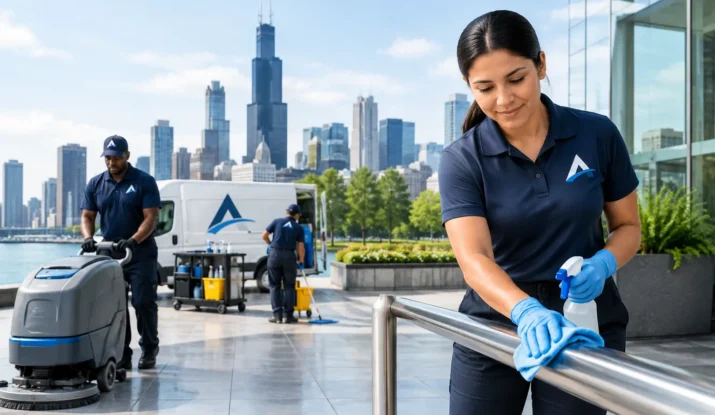
A restroom that runs out of soap during a busy shift, a loading dock with lingering waste, or a lobby floor that looks neglected after a wet Chicago morning can change how people judge an entire property. Chicago sanitation trends are pushing facility leaders to look beyond a basic cleaning checklist and manage cleanliness as an ongoing operational responsibility. The standard is not simply whether a building appears clean at the end of the day. It is whether restrooms stay supplied, high-touch areas receive consistent attention, floors hold up through weather, waste is controlled, and employees and visitors feel confident in the space.
For offices, schools, health care settings, restaurants, industrial facilities, and multi-tenant properties, sanitation now affects safety, satisfaction, asset life, and day-to-day productivity. The facilities that perform best are building practical systems around these expectations rather than reacting after complaints arise.
Chicago Sanitation Trends Facility Leaders Should Watch
Visible cleaning is becoming part of the customer experience
People notice the condition of a facility quickly. Smudged glass, overflowing trash, odors, stained carpet, and neglected entryways create a stronger impression than many property teams expect. This is especially true in customer-facing spaces, shared office buildings, hospitality environments, and retail locations where visitors may not see the work happening behind the scenes.
That does not mean teams need to clean every surface constantly. It means the cleaning plan should prioritize the spaces people use and judge most often: entrances, elevators, reception areas, restrooms, break rooms, touchpoints, and corridors. Day porter support can be particularly useful for high-traffic properties because it addresses spills, restroom checks, trash removal, and presentation issues while the building is occupied.
The trade-off is staffing and scheduling. A nightly crew may be sufficient for a small office with predictable occupancy. A busy medical office, school, restaurant, or multi-tenant building may need daytime attention as well. The right frequency depends on foot traffic, business hours, the type of occupants, and the level of presentation expected.
Sanitation is more targeted than broad disinfection
Routine cleaning, sanitizing, and disinfecting are related but different tasks. Cleaning removes dirt and debris. Sanitizing reduces germs on appropriate surfaces. Disinfection is generally used when a facility has a defined need for a higher level of germ reduction and the product is used according to its label directions.
A growing priority is applying the right process to the right area instead of treating every room the same way. High-touch points such as door hardware, elevator buttons, shared equipment, fixture handles, break room appliances, and checkout surfaces may require more frequent attention than low-contact areas. In health care, food service, education, and other sensitive settings, the plan may also need to account for occupancy patterns, department needs, and internal protocols.
Overusing chemicals can create its own problems, including residue, strong odors, damaged finishes, and unnecessary product costs. Well-trained teams use appropriate products, dwell times, dilution methods, and color-coded tools to help prevent cross-contamination between restrooms, kitchens, offices, and other zones. Microfiber tools and high-filtration vacuums also support a cleaner result by capturing soil rather than moving it from one surface to another.
Supply reliability is now a sanitation issue
A clean restroom is not fully functional if dispensers are empty or paper products run out halfway through the day. The same is true of gloves, hand soap, trash liners, floor mats, towels, and other everyday consumables. Facility managers are increasingly treating supply replenishment as part of sanitation planning rather than a separate purchasing task.
This shift matters because shortages often appear at the worst time: during a large meeting, a weekend event, a staffing gap, or a period of heavy seasonal traffic. A dependable program looks at usage rates, delivery timing, dispenser capacity, storage limits, and the facility’s busiest periods. It should also make ownership clear. When cleaning and supplies are handled by separate vendors without coordination, it is easy for each party to assume the other is monitoring inventory.
A single-provider approach can reduce that confusion. ABF Facility Services supports commercial clients with recurring cleaning alongside restroom products, toiletries, janitorial supplies, floor mats, gloves, reusable towels and mops, and restaurant linens and aprons. For many facilities, that means fewer vendor handoffs and a clearer path for reporting issues before they become service failures.
Weather-driven floor care remains a Chicago priority
Chicago facilities deal with a demanding mix of rain, snow, salt, slush, and windblown debris. Entryways and hard-surface floors absorb much of that impact. During winter and shoulder seasons, floors can become both a safety concern and an expensive maintenance issue if grit and moisture are allowed to remain on the surface.
Floor mats help, but mats alone are not a complete plan. They must be properly sized, placed, cleaned, and replaced when worn. Interior walk-off zones should be paired with scheduled vacuuming or extraction, spot mopping, and regular floor care suited to the material. Tile, grout, concrete, vinyl, polished floors, and carpet each require different methods.
Preventive care usually costs less than waiting for permanent staining, finish wear, or slip-and-fall concerns to develop. For industrial locations, the need may extend to degreasing, pressure washing, and removal of heavier soil. For offices and retail spaces, the priority may be maintaining a clean, safe appearance without interrupting normal operations. The method should fit the facility, not the other way around.
How Chicago Sanitation Trends Are Changing Vendor Expectations
Facility decision-makers are placing more value on accountability. A cleaning provider should not only complete assigned tasks but also communicate clearly, arrive as scheduled, identify concerns, and respond when the building’s needs change. Uniformed, insured, OSHA-compliant teams help establish a professional standard, but consistency is proven through execution over time.
That includes quality-control routines. Supervisory checks, clear scope documentation, service logs where appropriate, and a direct way to report concerns all help protect the client from the familiar problem of inconsistent crews. For property managers, this can reduce tenant complaints. For operations leaders, it can reduce the time spent chasing multiple vendors. For business owners, it protects the environment employees and customers experience every day.
Environmental considerations are also becoming more practical. Many facilities want cleaning programs that support their sustainability goals, but they still need products that perform. Green Seal-certified products, controlled chemical dispensing, microfiber systems, and durable reusable tools can help reduce unnecessary waste while maintaining sanitation standards. The best choice depends on the building’s needs, the surfaces being cleaned, and any industry-specific requirements.
Waste, pests, and neglected exterior areas are connected
Sanitation does not stop at the restroom door or office corridor. Waste accumulation, dumpster-area conditions, food debris, and clutter can contribute to odors, pest activity, and an overall sense that a property is poorly maintained. In restaurants, warehouses, multifamily common areas, and industrial settings, these issues can escalate quickly if no one is assigned to monitor them.
A more complete sanitation plan considers indoor cleaning, trash handling, junk removal, pest control, and exterior maintenance together. Pressure washing can improve the condition of sidewalks, docks, and entrances. Scheduled trash removal can prevent overflow. Pest-control programs are more effective when sanitation conditions limit access to food, water, and hiding places.
This does not mean every site needs every service on a recurring basis. A facility with limited public traffic may only need periodic specialty work. A restaurant or high-volume commercial property may need frequent monitoring. The practical question is whether the scope matches the risks and traffic of the property.
Building a More Reliable Sanitation Program
The strongest sanitation programs begin with a walkthrough, not a generic bid sheet. Decision-makers should identify high-traffic zones, restroom demand, special surfaces, shift schedules, waste streams, supply use, seasonal concerns, and areas that regularly generate complaints. From there, the cleaning schedule can be built around actual conditions.
It also helps to establish measurable expectations. Instead of asking for a building to be “clean,” define the result: stocked dispensers at opening, clean and dry entry floors, removal of visible trash, scheduled touchpoint service, documented specialty floor care, and timely response to spills or urgent concerns. Clear expectations give both the client and service team a better way to verify quality.
Finally, review the plan as the facility changes. Occupancy can increase, a tenant can move in, construction can create extra dust, or a business can add hours. A sanitation plan that worked six months ago may need a different frequency or service mix now.
A well-maintained facility sends a simple message: the people inside matter. When cleaning, supplies, floor care, waste control, and responsive service work together, sanitation becomes less of a recurring problem and more of a dependable part of how the property operates.