
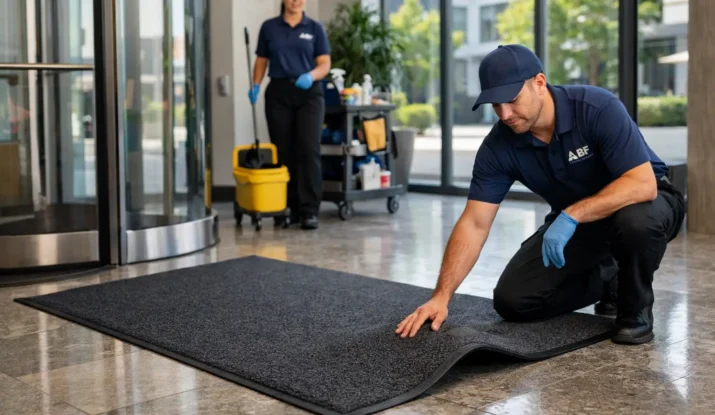
A rainy Chicago morning can turn a clean lobby, retail aisle, or office entry into a slip risk within minutes. The right commercial floor mats do more than improve appearance: they capture water, grit, salt, and debris before those contaminants reach hard flooring, carpet, and the people walking across them.
For facility managers, that makes mats a practical part of a larger cleaning and safety program. A mat that is too small, poorly placed, curled at the edges, or left saturated can create the very problem it was meant to prevent. The goal is not simply to put a mat at every door. It is to build a mat program that fits traffic levels, weather exposure, floor types, and the way your facility operates.
Why Commercial Floor Mats Matter
Entryways carry more than foot traffic. They carry abrasive soil that can scratch finished floors, moisture that increases slip-and-fall exposure, and deicing residue that can leave white film behind. In restaurants, healthcare facilities, schools, manufacturing areas, and high-traffic office buildings, these materials spread quickly when they are not stopped at the door.
Quality mats reduce the amount of soil your cleaning crew must remove from surrounding floors. That can lower the frequency of emergency mopping, help preserve floor finish, and reduce the wear that makes carpet look tired before its time. A cleaner entrance also supports the first impression visitors, tenants, patients, and customers form before they reach the front desk.
The return is not limited to appearance. Controlling tracked-in moisture helps support safer walking surfaces. It also protects the investment in hard-floor care, carpet cleaning, and replacement. A mat program works best when it is treated as preventive maintenance, not a decorative afterthought.
Match Commercial Floor Mats to Each Zone
One entrance mat cannot solve every floor-care problem. Facilities often need different mat styles at the exterior door, interior vestibule, reception area, service counter, break room, and work area.
Exterior scraper mats
Exterior scraper mats are built to remove larger particles, mud, road salt, and debris from shoe soles before people enter the building. They are especially useful at busy public entrances, loading access points, and employee doors exposed to parking lots. In Chicagoland, where snow, slush, and salt are regular winter concerns, an exterior scraper mat can reduce the amount of material brought inside.
These mats need a stable backing and a profile that holds its shape. A lightweight mat may shift under traffic or bunch at corners, creating a safety concern. The trade-off is that aggressive scraper surfaces are functional, but they are not always the best choice for polished reception areas where a more refined appearance is needed.
Interior wiper mats
Inside the door, wiper mats absorb the moisture and finer particles left after the initial scrape. They should be long enough for several steps, not just one. If visitors can step around the mat in a single stride, it is unlikely to capture much water.
For many facilities, the most effective setup uses a scraper mat outside and an absorbent wiper mat inside. A covered vestibule may need both functions in one mat or a longer runner that allows shoes to dry before occupants reach tile, luxury vinyl, or carpet.
Logo and message mats
Logo mats can make an entrance feel organized and reinforce a professional brand image. They work well in lobbies, leasing offices, retail spaces, hotels, and customer-facing service areas. However, design should not override performance. A logo mat still needs sufficient absorbency, skid resistance, and size for the traffic it receives.
A branded mat is most effective after the facility has addressed the core needs of soil removal and moisture control. It can be the finishing detail in an entry program, not the entire program.
Anti-fatigue and safety mats
Standing mats serve a different purpose. In kitchens, production lines, cashier stations, laboratories, and packing areas, anti-fatigue mats can provide cushioning for employees who stand for long periods. In wet or greasy work zones, drainage and slip-resistant surfaces are essential.
These mats should be selected carefully because a comfortable mat is not automatically appropriate for every work environment. Grease, chemicals, heat, carts, and cleaning procedures all affect the right material. Managers should also confirm that mat edges stay flat and that the mat can be cleaned thoroughly without trapping contaminants.
Size Is a Safety Decision
A common mistake is choosing mats based on the doorway width alone. The better question is: how far do people walk before they reach unprotected flooring? A wider, longer mat system gives shoes more contact time and captures more moisture.
At a main entrance, coverage should account for two-way traffic, people carrying bags, rolling carts, and visitors who may enter in groups. Side doors used by employees can require a different layout than a public lobby, particularly if workers enter directly from a loading area or parking lot.
Large mats do have trade-offs. They require more space, more frequent service, and proper placement so doors open freely. Yet undersized mats frequently lead to wet-floor conditions around their edges, which creates extra work for cleaning teams and can leave a poor impression during bad weather.
Service Frequency Keeps Mats Effective
Even high-quality mats stop working when they are overloaded with water and soil. A dark, saturated mat may hide the extent of contamination, but it cannot continue absorbing moisture indefinitely. Service frequency should be based on conditions, not a fixed schedule that ignores seasonal changes.
A medical office with moderate traffic may need a different replacement cycle than a restaurant entrance, school corridor, warehouse office, or multi-tenant building lobby. Winter weather, construction activity, landscaping debris, and special events can all increase soil levels quickly.
During wet or snowy periods, facilities may need additional mat changes, larger temporary runners, and more frequent attention to entrance floors. Staff should inspect mats throughout the day for curling, movement, visible saturation, and soil that has spilled onto nearby flooring. Wet-floor signs and prompt spot mopping still matter, even with an excellent mat system in place.
Rental Versus Purchasing Mats
Both rental and purchased commercial floor mats can be appropriate. The right choice depends on your facility’s traffic, internal laundry capability, storage space, and need for predictable maintenance.
A managed rental program can simplify the process. Mats are picked up, professionally cleaned, replaced, and returned on a recurring schedule. This approach helps maintain a consistent appearance and avoids asking in-house staff to wash, dry, store, and rotate heavy mats. It can be particularly useful for facilities with several entrances or changing seasonal conditions.
Purchasing may make sense for specialty applications, low-traffic areas, or locations where a custom mat is expected to remain in place for an extended period. The responsibility for cleaning and replacement remains with the facility, though. If purchased mats are not cleaned correctly, they can retain odors, lose absorbency, or deteriorate faster than expected.
The best option is the one that ensures mats remain clean, flat, and functional every day. A lower upfront price does not help if the mat is neglected or needs frequent replacement.
Coordinate Mats With Your Floor-Care Plan
Mats are most effective when they support the rest of the cleaning program. Daily vacuuming, spot cleaning, and scheduled floor maintenance prevent captured soil from migrating back onto walking surfaces. Hard floors near entrances may also need extra attention during winter, when salt residue can damage appearance and leave a slippery film.
Color-coded cleaning tools and dedicated entrance-cleaning procedures help reduce cross-contamination between restrooms, food-service areas, work zones, and public spaces. High-filtration vacuuming is particularly useful around carpeted entries, where fine grit can settle below the surface and wear carpet fibers over time.
A facility assessment should consider more than the front door. Look at employee entrances, shipping doors, elevator lobbies, break rooms, reception counters, and any place where water, debris, or standing work occurs. The most overlooked entrance is often the one creating the most floor-care cost.
A Better Standard for Everyday Protection
Commercial floor mats should make a facility easier to manage, not create another recurring problem. When they are correctly sized, placed in the right zones, serviced often enough, and coordinated with routine cleaning, they help protect people, flooring, and the professional image of the property.
ABF Facility Services can help Chicagoland businesses align mat rental, janitorial service, consumable supply, and floor care under one accountable plan. A quick review of your entrances and traffic patterns can reveal where a better mat setup will keep dirt outside, floors cleaner, and daily operations moving safely.