
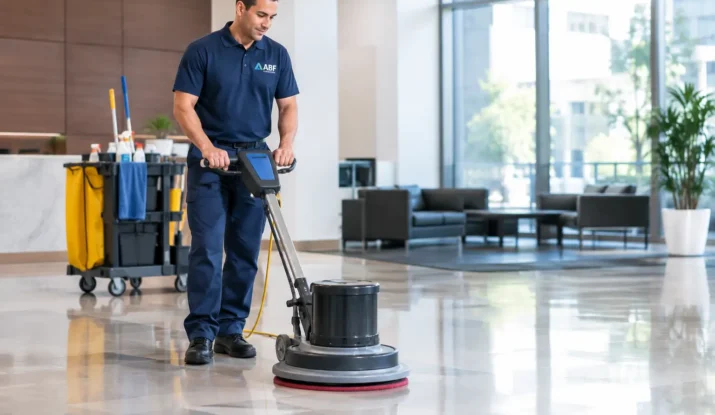
A dull lobby floor, slippery restroom tile, or carpet that holds visible traffic lanes can change how people judge an entire property. The best commercial floor care equipment does more than improve appearance. It helps protect flooring assets, reduce slip risks, control soil, and support a cleaner environment for employees, tenants, patients, students, and customers.
For facility managers, the right equipment is not always the largest or most expensive machine. A successful floor care program matches equipment to the floor material, building traffic, cleaning schedule, storage space, and staff capability. The goal is dependable results without unnecessary labor, water use, chemical waste, or disruption to daily operations.
Start With the Floor and the Facility
Commercial floor care begins with identifying what is underfoot. Vinyl composition tile, luxury vinyl tile, ceramic tile, concrete, terrazzo, natural stone, carpet, rubber flooring, and epoxy coatings all have different care requirements. Using an aggressive pad, unsuitable cleaner, or too much water can leave permanent damage behind.
Traffic patterns matter just as much. An office corridor may need daily vacuuming and periodic detail work, while a warehouse aisle needs equipment that can handle dust, pallet debris, and tire marks. A medical or educational setting may require quiet operation and efficient daytime cleaning around occupants. Restaurants need fast response to grease, spills, and wet floors, often outside regular business hours.
Before purchasing or scheduling equipment, document the floor types, square footage, problem areas, access points, and available storage. This assessment prevents a common mistake: selecting one machine to solve every floor-care need.
The Best Commercial Floor Care Equipment by Task
A complete program usually uses several equipment types. Each one has a specific role, and the best results come from using them at the right interval.
Commercial Vacuums With High-Filtration Performance
Vacuuming is foundational for carpeted areas and is also useful for capturing dry debris before hard-floor cleaning. Commercial upright vacuums work well for open carpeted office spaces, while backpack vacuums offer flexibility in stairwells, tight areas, and spaces with frequent furniture. Canister or specialty vacuums can be a better fit for edges, upholstery, vents, and hard-to-reach surfaces.
High-filtration models are especially valuable in facilities concerned with dust, allergens, and indoor air quality. Strong suction alone is not enough. The vacuum should capture fine particles effectively, have filters maintained on schedule, and be used with proper technique. A full bag, clogged filter, or worn brush roll reduces performance quickly.
Automatic Floor Scrubbers
For large hard-floor areas, an automatic scrubber is often the most productive piece of equipment available. It applies cleaning solution, agitates the surface with a pad or brush, and recovers dirty water in one pass. This supports cleaner floors and shorter drying times than mopping alone.
Walk-behind scrubbers are a practical choice for medium-sized spaces such as retail floors, school hallways, office common areas, and restrooms. Ride-on scrubbers can make sense for warehouses, distribution centers, large manufacturing spaces, and expansive institutional facilities where labor efficiency is critical.
The trade-off is that scrubbers require operator training, routine battery or charging maintenance, clean recovery tanks, and enough storage space. They also need the correct brush or pad for the floor. A machine that is too large may be difficult to maneuver, while one that is too small may create unnecessary labor costs.
Burnishers and Buffers for Finished Floors
High-speed burnishers restore gloss to properly maintained resilient flooring, especially VCT in lobbies, corridors, and other high-visibility areas. They are not a substitute for cleaning. Burnishing works best after soil has been removed and the finish is in good condition.
Low-speed buffers are more versatile for scrubbing, stripping, and certain restorative tasks, depending on the pad and process. These machines can produce excellent results, but they require trained operators. Incorrect pad selection or poor technique can scuff surfaces, remove finish unevenly, or create safety concerns.
Floor finish programs should be based on real floor conditions rather than a fixed calendar alone. Some facilities benefit from routine spray buffing and periodic burnishing, while others need a deeper scrub and recoat schedule. Full stripping may be appropriate when finish has accumulated heavily, yellowed, or failed, but it is labor-intensive and should not be overused.
Carpet Extractors and Encapsulation Machines
Carpet needs more than regular vacuuming. Spots, oily traffic lanes, and embedded soil can make carpet look worn long before its useful life is over. Hot-water extraction machines use solution and recovery to remove deeper soil, while low-moisture encapsulation equipment is designed for faster drying and routine appearance management.
Extraction can be highly effective for periodic restorative cleaning, particularly where carpet has not received consistent care. However, excessive moisture or poor extraction can lead to extended drying times and potential odor concerns. Encapsulation is often a strong maintenance option between deeper cleanings, especially in offices, hotels, schools, and other spaces that need to reopen quickly.
Wet/Dry Vacuums, Edge Tools, and Detail Equipment
The most visible floor problems often happen at the edges: along baseboards, under shelving, around restroom fixtures, and at entryways. Wet/dry vacuums, grout brushes, corner tools, and compact cleaning equipment help crews reach these neglected areas.
These tools may not appear as impressive as a ride-on scrubber, but they are essential. A floor can be mechanically cleaned in the center and still look poorly maintained if soil builds up in corners and along walls. Detail work is where quality control becomes visible.
How to Choose Equipment That Fits Your Operation
The right purchase or service plan should balance cleaning performance with the realities of the property. Consider these factors before committing to a machine:
- Floor material and manufacturer care recommendations
- Daily traffic volume, soil type, and spill frequency
- Square footage and the width of aisles, doorways, and elevators
- Available storage, charging access, water access, and drainage
- Noise restrictions and the hours when cleaning can occur
- Staff training needs, maintenance requirements, and replacement parts
Facilities with several floor types often benefit from a coordinated equipment plan rather than trying to rely on one multipurpose machine. For example, a Chicago-area medical office may need a high-filtration vacuum for carpeted administrative areas, a compact scrubber for resilient flooring, and specialty tools for restrooms and entrances. A distribution center may prioritize a ride-on scrubber, wet/dry recovery equipment, and concrete-specific cleaning solutions.
Equipment Is Only as Good as the Process Behind It
Even the best machine will not correct an inconsistent cleaning process. Floor care depends on proper chemical dilution, pad selection, dwell time, recovery, and routine inspection. It also depends on stopping soil before it spreads through the building.
Entry mats are one of the most cost-effective parts of a floor care strategy. They capture moisture, salt, grit, and debris at the door, which is particularly important during Chicagoland winters. Clean, properly sized mats help reduce tracked-in soil that can scratch hard surfaces, stain carpet, and increase slip hazards.
Color-coded microfiber mops and tools also support better results by reducing cross-contamination between restrooms, break areas, offices, and other zones. When paired with trained staff and sustainable cleaning products selected for the surface, these systems can reduce excess chemical and water use without lowering cleaning standards.
Preventive maintenance matters for machines, too. Empty and rinse tanks after use, inspect squeegees and brushes, charge batteries correctly, replace worn pads, and address leaks or suction issues promptly. Equipment downtime can force teams back to inefficient manual methods at the worst possible time.
When Professional Floor Care Makes More Sense
Some daily tasks can be handled by an in-house team, particularly in smaller facilities with simple floor layouts. Specialty projects, restorative carpet cleaning, floor stripping and refinishing, concrete care, and large-scale scrubbing often require more technical experience and equipment than a property keeps on site.
A professional provider can evaluate floor condition, recommend an appropriate service frequency, and bring the correct machines and materials for the job. This approach can be especially useful when a facility is preparing for inspections, tenant turnover, seasonal weather, a grand opening, or a major event.
ABF Facility Services helps businesses throughout Chicago and surrounding suburbs build practical hard-floor and carpet-care programs around their actual facility needs. Trained, uniformed, insured teams use advanced equipment, high-filtration vacuums, microfiber systems, and surface-appropriate products to support clean, safe, presentable spaces.
The best choice is the equipment and process that keep floors consistently clean between major service visits, protect the finish or fibers underneath, and give everyone who enters the building confidence that the property is cared for.