
A warehouse floor can look acceptable from the office doorway while creating real risk at ground level. Fine dust collects around racking, shrink-wrap scraps drift into travel lanes, and oil residue near docks turns a routine forklift route into a slip hazard. The best warehouse cleaning methods address those conditions before they affect employee safety, product quality, equipment performance, or daily throughput.
Warehouse cleaning is not a single after-hours task. It is an organized program that matches the building’s traffic patterns, materials, machinery, inventory requirements, and operating schedule. A high-volume distribution center needs a different approach than a light manufacturing warehouse, refrigerated storage area, or retail backroom. The goal is consistent control of dust, debris, spills, and waste without disrupting the work that keeps the facility moving.
1. Build Cleaning Zones Around Real Warehouse Activity
A practical cleaning plan starts by dividing the facility into zones based on risk and use, not simply square footage. Dock doors, staging areas, battery-charging stations, production lines, break rooms, restrooms, offices, and rack aisles all accumulate different types of soil and require different cleaning frequencies.
High-traffic forklift lanes and pedestrian walkways generally need attention every day. Low-traffic storage aisles may need scheduled sweeping and periodic detailed cleaning instead. Areas around loading docks often require more frequent debris removal because outdoor dirt, pallet fragments, and packaging waste enter continuously.
Assigning zones also makes accountability easier. Supervisors can verify that critical areas are serviced, identify repeat problem spots, and adjust the schedule as seasonal conditions or production demands change. In Chicagoland, winter adds another layer of concern: salt, slush, and moisture tracked in through dock doors can quickly damage floors and increase slip-and-fall exposure.
2. Use Mechanical Sweeping for Large Floor Areas
For expansive concrete floors, walk-behind or ride-on sweepers are usually more efficient than manual sweeping. Mechanical sweeping captures loose dust, wood splinters, cardboard fibers, and debris before those materials are carried through the facility by tires and foot traffic.
The right equipment depends on aisle width, square footage, obstructions, and the type of debris present. A compact walk-behind unit may be appropriate for narrow aisles and smaller facilities, while a ride-on sweeper can help maintain large open warehouse floors quickly. Manual brooms still have a place for corners, under racking, and areas equipment cannot reach, but they should support the main process rather than replace it.
Dry sweeping can also create airborne dust when done improperly. High-filtration vacuums and properly maintained sweeping equipment help capture fine particulate matter instead of redistributing it. This matters especially in facilities storing sensitive inventory, food-related packaging, electronics, or materials that can be affected by dust contamination.
3. Scrub Floors Instead of Just Moving Dirt Around
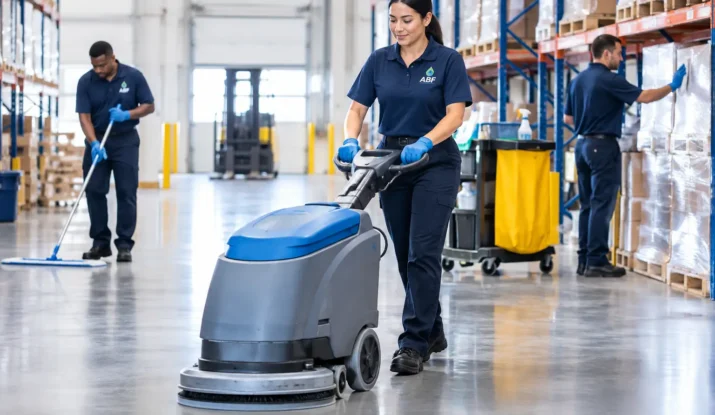
Sweeping removes loose debris, but it does not remove the film of grime that builds up from forklift tires, tracked-in water, oil, and daily traffic. Auto-scrubbers use cleaning solution, agitation, and recovery vacuum systems to lift soil from hard surfaces and collect the dirty water in the same pass.
Routine floor scrubbing improves appearance, but the larger benefit is safety. Clean floors make painted lines, warning markings, and surface hazards easier to see. Removing residue can also reduce slippery conditions, particularly near docks, entrances, battery areas, and locations where condensation occurs.
Cleaning chemistry should fit the floor and the soil. A neutral cleaner may be suitable for regular maintenance, while degreasers may be needed around maintenance bays or production equipment. Using an overly aggressive product can damage coatings, leave residue, or create an unnecessary safety issue. A trained cleaning team should follow manufacturer guidance, dilution requirements, and site-specific safety procedures.
4. Treat Spills as a Response Process, Not a Cleaning Task
A spill response plan should be clear enough that every employee knows what to do before a cleaning crew arrives. That includes securing the area, using warning signage, identifying the material, and following the appropriate procedure for cleanup or escalation.
Water, oil, chemicals, food products, and unknown liquids cannot be handled the same way. Absorbent materials may be appropriate for small oil leaks, while chemical spills may require safety data sheet guidance, personal protective equipment, containment procedures, or specialized disposal. Never ask janitorial staff to handle hazardous materials without the training, equipment, and authorization required for that material.
Stock spill kits where they are most likely to be needed: at receiving docks, battery-charging areas, maintenance rooms, and production zones. Inspect the kits regularly so absorbents, gloves, bags, and warning materials are available when an incident occurs.
5. Control Dust on Racking, Ledges, and Overhead Surfaces
Floor care gets the most attention because it is visible, but overhead dust control is one of the best warehouse cleaning methods for protecting inventory and indoor air quality. Dust can accumulate on racking beams, light fixtures, sprinkler piping, ductwork, ceiling fans, and top surfaces that are rarely inspected.
When disturbed by air movement or forklift traffic, that dust can settle on products, packaging, workstations, and floors that were cleaned earlier. In some operations, accumulated dust may also create fire-safety or product-quality concerns.
High dusting should be scheduled based on the environment, not treated as a once-a-year cosmetic project. A warehouse with active manufacturing, frequent loading activity, or open dock doors may need more regular service than a climate-controlled storage facility. The work should be performed with the proper access equipment, fall-protection practices, and safeguards for nearby inventory and operations.
6. Keep Loading Docks and Waste Areas Under Control
Loading docks are transition points between the outside environment and the warehouse. They attract dirt, leaves, water, exhaust residue, broken pallet pieces, stretch wrap, and discarded packaging. If waste is allowed to build up, it can block paths, damage equipment, attract pests, and make a busy operation look unmanaged.
A reliable dock-cleaning routine includes debris removal, sweeping, spot treatment for spills, and regular inspection of corners, dock plates, and door thresholds. Exterior pressure washing can be useful for concrete aprons, dumpster pads, and heavily soiled entry areas, but it should be planned carefully to manage runoff and avoid interfering with shipping schedules.
Waste removal should also be matched to volume. Overflowing trash and cardboard create operational delays and increase pest risk. Separate recycling, general waste, damaged materials, and regulated waste streams so employees are not left guessing where items belong.
7. Clean Restrooms, Break Rooms, and Offices With the Same Discipline
Employee areas are part of warehouse cleanliness, not an afterthought. Restrooms, locker rooms, break rooms, and offices directly affect morale, visitor impressions, and hygiene. They also require a different cleaning approach than industrial floor space.
Restrooms need consistent cleaning and replenishment of soap, paper products, liners, and other supplies. Break rooms require attention to food spills, tables, appliances, sinks, and waste containers that can become odor or pest issues. Color-coded cleaning systems help prevent cross-contamination by keeping restroom tools separate from those used in offices, break rooms, and warehouse areas.
Supply management is a frequent point of failure. A clean restroom that runs out of soap or paper towels is not fully functional. Consolidating cleaning service and recurring consumable replenishment can reduce last-minute purchasing and give facility managers one accountable point of contact.
8. Schedule Deep Cleaning Around Your Operation
Daily service maintains order. Periodic deep cleaning corrects the buildup that routine work cannot fully address. This may include detailed rack cleaning, floor stripping or coating maintenance, pressure washing, carpet care in office areas, high dusting, and cleaning behind equipment or under stored materials.
The best timing depends on your operation. Some facilities can support cleaning during slower shifts; others need weekend, overnight, or phased service to keep shipping and production moving. The trade-off is straightforward: cleaning around active traffic can be less disruptive to staffing, but may take longer and require more area controls. A planned shutdown window can allow a more thorough result in less total time.
Before scheduling specialty work, walk the site with the service provider. Identify access restrictions, security requirements, sensitive inventory, vehicle routes, drainage points, electrical hazards, and areas that must remain operational. A detailed scope prevents surprises and helps ensure the right people, equipment, and products arrive prepared.
Measure Results and Adjust the Plan
A warehouse cleaning program should be reviewed like any other operational process. Look for recurring floor residue, repeated spills, dust on inventory, restroom supply outages, pest activity, employee complaints, or areas where debris returns immediately after cleaning. Those patterns often point to a scheduling gap, equipment issue, workflow problem, or need for different cleaning methods.
ABF Facility Services helps warehouses and industrial properties build customized cleaning plans with trained, uniformed, insured, OSHA-compliant teams, specialized floor-care equipment, and ongoing supply support. The most effective plan is the one your team can rely on shift after shift – protecting the people, products, and equipment that keep your operation productive.