
A Chicago property upkeep guide has to account for more than a standard cleaning schedule. A lobby can look polished on Monday and show salt residue by Wednesday. A warehouse floor can be safe in summer and become a slip risk after one wet winter shift. For commercial property managers, office managers, and operations leaders, upkeep is the daily work of protecting the building, supporting occupants, and preventing small issues from becoming expensive disruptions.
Chicago facilities face a demanding mix of snow, road salt, rain, wind, humidity, heavy pedestrian traffic, and seasonal pest pressure. The right plan is not simply about cleaning more often. It is about assigning the right task, frequency, equipment, and accountability to each area of the property.
Build a Chicago Property Upkeep Guide Around Risk
Start by dividing the facility into zones based on how people use them and what can go wrong there. A customer-facing entrance, a busy restroom, a break room, a loading dock, and a mechanical corridor do not need the same level of attention. Treating them as though they do often wastes labor in low-risk spaces while visible or safety-sensitive areas fall behind.
Entrances and common areas deserve close attention because they shape first impressions and collect the most outside debris. Restrooms need scheduled cleaning and supply checks because depleted soap, paper products, or sanitizer affect both hygiene and employee confidence. In industrial settings, dock areas, production support spaces, and floor transitions require a plan that considers dust, debris, oils, equipment traffic, and pedestrian safety.
A practical inspection routine should identify conditions before complaints begin. Walk the property at different times of day, including after peak arrival periods, lunch, shift changes, and deliveries. Look for floor moisture, overflowing waste, odors, fingerprints on high-touch surfaces, loose mats, low supplies, stained carpet paths, and signs of pest activity. Documenting these observations creates a clearer service scope than relying on a general instruction to “keep the building clean.”
Protect Floors From Chicago Weather and Traffic
Floor care is one of the clearest examples of why seasonal upkeep matters. Winter salt and ice melt can scratch hard surfaces, dull finishes, discolor carpet, and create slippery conditions when moisture is tracked indoors. During spring and fall, rain and mud create many of the same problems. A floor that appears clean can still have residue that shortens its life or affects traction.
Use properly sized entrance matting to capture moisture and soil before it reaches the interior. Mats need regular vacuuming, extraction, and replacement or rotation when they become saturated or curl at the edges. They are a first line of defense, not a set-it-and-forget-it purchase.
Hard floors need a maintenance program matched to the material. Vinyl composition tile may require routine burnishing and periodic stripping and refinishing. Ceramic tile and grout need targeted cleaning to remove buildup without damaging the surface. Concrete in industrial areas may call for mechanical scrubbing, degreasing, or pressure washing depending on the work being performed nearby. Carpet benefits from frequent vacuuming with high-filtration equipment, prompt spot treatment, and scheduled deep extraction before traffic lanes become permanently visible.
Frequency depends on occupancy and exposure. A medical office lobby, restaurant entry, or busy retail site may need multiple checks each day during wet weather. A low-traffic professional office may need less frequent service but still needs a rapid response plan for spills and tracked-in salt.
Keep Restrooms Clean, Stocked, and Functional
Restroom upkeep is an operations issue as much as a cleaning issue. A clean restroom with empty soap dispensers is not fully functional. A stocked restroom with soiled fixtures is not acceptable either. Both conditions lead occupants to question how well the rest of the facility is managed.
Set service frequencies according to the number of users, visitor volume, and operating hours. High-use restrooms should receive repeated checks for soap, tissue, towels, liners, odor control, and surface cleanliness. Lower-traffic restrooms may not need constant attention, but they still require consistent cleaning and a reliable restocking schedule.
Supply management is especially valuable when one person is responsible for many facility details. Standardize approved products and establish minimum inventory levels for restroom paper, hand soap, sanitizer, liners, gloves, and cleaning chemicals. This reduces rushed purchases, incompatible dispenser products, and avoidable shortages. For facilities with public traffic, a clear record of restroom service checks can also help managers respond to concerns quickly and accurately.
Manage Waste Before It Becomes a Safety or Pest Issue
Waste accumulation is rarely just an appearance problem. Overflowing containers can create odors, attract pests, block work areas, and increase the chance of leaks or trip hazards. Food waste in break rooms, restaurants, hospitality spaces, and shared offices deserves particular attention because even a short delay in removal can create a sanitation concern.
Match container size and collection frequency to actual use rather than assumptions. Review trash volume after events, seasonal changes, tenant turnover, or shifts in staffing. If bins are consistently overfilled before pickup, the answer may be a different container location, more liners, a revised collection schedule, or additional capacity.
Junk removal should also be planned, especially during office moves, renovations, lease transitions, or warehouse reorganizations. Leaving unwanted furniture, damaged equipment, cardboard, or scrap materials in hallways and storage rooms can create access problems and make routine cleaning far less effective. Remove large items promptly and keep designated storage areas clearly defined.
Use Seasonal Planning Instead of Emergency Calls
Chicago weather changes the condition of a commercial property quickly. A seasonal plan helps facility teams prepare rather than react.
During winter, prioritize entrance matting, salt-residue removal, wet-floor response, snow-related debris, and extra inspections of high-traffic paths. Make sure cleaning teams know where wet-floor signs, replacement mats, liners, and approved floor chemicals are kept. Avoid using a single harsh product on every surface, since the wrong cleaner can damage finish or leave slippery residue.
Spring is a good time for deep carpet cleaning, hard-floor restoration, exterior pressure washing, window-adjacent detailing, and removal of winter grime near doors and loading areas. It is also a useful period to inspect for moisture damage, pests, and debris that accumulated in less visible exterior areas.
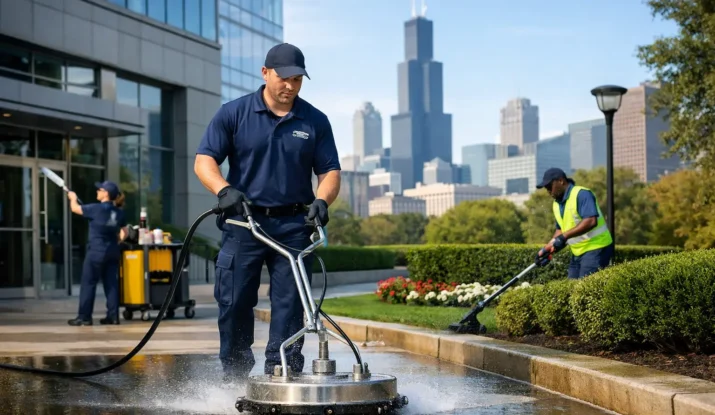
Summer often brings higher foot traffic, construction dust, humidity, and more frequent use of outdoor spaces. Review waste service, restroom supply needs, pest-control activity, and pressure washing for sidewalks, dumpsters, patios, and loading areas. In schools and many offices, summer may provide a practical window for larger floor-care projects that would be disruptive during regular operations.
Fall is preparation season. Inspect mats, confirm winter supply levels, schedule preventive floor work, clear exterior debris, and verify that drainage areas are not obstructed. The best time to address worn flooring or inadequate entry protection is before the first prolonged period of snow and slush.
Choose Vendors Based on Accountability, Not Just Task Lists
Commercial property upkeep often involves several moving parts: janitorial service, floor care, consumables, sanitation, pressure washing, pest control, and removal work. Using separate vendors can be appropriate for highly specialized needs, but it also creates more scheduling, invoicing, and communication work for the property team.
For many facilities, consolidating routine services with one accountable provider simplifies oversight. The real value is not merely fewer invoices. It is having a team that understands the building’s service standards, knows which supplies belong in each restroom, recognizes recurring floor issues, and can coordinate specialty work without requiring the manager to start from zero each time.
Ask practical questions before setting a service agreement. Who performs quality checks? How are missed tasks reported and corrected? Are workers trained, uniformed, insured, and OSHA compliant? What is the response process for an urgent spill, sanitation concern, or removal need? Are environmentally responsible products available where they fit the facility’s requirements? Clear answers matter more than vague promises of a “customized” program.
Make Upkeep Measurable
A property upkeep plan should be reviewed using observable results. Tenant complaints, restroom stockouts, slip incidents, floor appearance, odor concerns, pest sightings, and emergency supply purchases all reveal where the plan is falling short. Track these patterns monthly and adjust service frequency or scope when the data supports it.
Quality checks should be specific enough to be useful. Instead of marking a lobby as simply “clean,” evaluate whether glass is free of fingerprints, mats are dry and flat, waste is removed, floors are free of visible residue, and high-touch points are addressed. That level of detail helps managers and service partners resolve issues consistently.
ABF Facility Services supports Chicago-area commercial facilities with integrated cleaning, maintenance, sanitation, supply, and specialty service designed around the way each property operates. The most effective upkeep program is the one that prevents daily friction for employees, tenants, customers, and managers, while protecting the condition of the building over time.
A well-kept property does not announce itself through a long checklist. People notice it because entrances feel safe, restrooms work, floors hold up, supplies are available, and the facility is ready for business every day.