
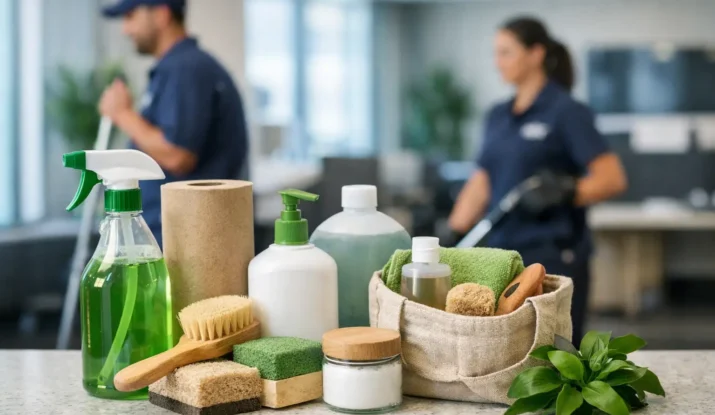
A sustainable product decision is rarely just about replacing one bottle with another. For facility managers, the best sustainable janitorial products must clean effectively, support occupant health, fit the facility’s surfaces and traffic levels, and remain practical for the cleaning team to use every shift. A product that carries an environmental claim but leaves floors sticky, requires extra labor, or arrives in unreliable quantities is not a complete facility solution.
For offices, schools, health care settings, restaurants, warehouses, and multi-tenant properties, the strongest approach combines verified cleaning chemistry with reusable tools, controlled dispensing, and dependable replenishment. The result is a cleaner building with less waste, fewer avoidable supply costs, and a more consistent experience for employees, tenants, and visitors.
What Makes a Janitorial Product Truly Sustainable?
Sustainability should be evaluated across the product’s full use cycle, not its label color or marketing language. A responsible product performs its intended job with ingredients, packaging, and usage practices that reduce unnecessary environmental impact. In commercial cleaning, performance still comes first. If a general-purpose cleaner cannot remove the soil common to your facility, staff may overuse it, repeat the work, or turn to a harsher backup chemical.
Look for credible third-party certifications, such as Green Seal certification, when selecting cleaners, paper products, and other consumables. These standards help buyers identify products evaluated against established environmental and health criteria. Certification is not the only purchasing factor, but it provides more confidence than broad terms such as “green,” “natural,” or “eco-friendly” alone.
Concentrated formulas also deserve close attention. Properly diluted concentrates can reduce shipping weight, storage needs, packaging waste, and cost per ready-to-use gallon. However, they require clear training and reliable dilution-control equipment. For a small location with limited storage or no trained custodial staff, ready-to-use products may be the more dependable choice despite generating more packaging.
Best Sustainable Janitorial Products by Facility Need
The best product mix depends on the facility, its occupants, the surfaces being cleaned, and applicable sanitation requirements. A corporate office may prioritize low-odor products and carpet appearance, while a food-service operation may need products that meet stricter degreasing and sanitizing demands.
Certified all-purpose cleaners
A high-quality, neutral-pH all-purpose cleaner is the foundation of a sustainable janitorial program. It should handle routine dust, fingerprints, light soils, and everyday spills on approved hard surfaces without leaving residue or creating an overpowering fragrance.
For common areas, desks, lobbies, break rooms, and restrooms, choose a product with clear dilution instructions, labeled surface compatibility, and recognized third-party certification when available. Avoid using a heavy degreaser as a routine cleaner. Stronger chemistry has a place in kitchens, industrial settings, and high-soil areas, but using it everywhere can increase product consumption and risk surface damage.
Low-impact restroom cleaners and disinfectants
Restrooms require a practical balance between sustainability and sanitation. Bowl cleaners, restroom disinfectants, hand soap, tissue, towels, and feminine hygiene supplies all affect waste volume, indoor air quality, user experience, and operating cost.
Select toilet and urinal cleaners that remove mineral buildup efficiently without unnecessarily harsh acids for routine maintenance. For disinfectants, use products registered for the required claims and follow the label precisely, especially regarding contact time. Disinfecting is not the same as cleaning. Soil must often be removed first, and spraying a product then wiping it away immediately may fail to achieve the intended result.
No single disinfectant is right for every facility. Health care environments, schools, restaurants, and general office buildings can have different protocols. The sustainable choice is the product that meets the required sanitation standard without being overapplied or misused.
Microfiber cloths, reusable mops, and color-coded tools
Some of the most effective sustainable improvements are not chemicals at all. Durable microfiber cloths and reusable mop systems can reduce reliance on disposable wipes and inefficient cotton products. Microfiber captures dust and soil effectively with less water and can improve cleaning consistency when laundered correctly.
Color-coded cleaning tools are equally valuable. Assigning separate colors to restrooms, kitchens, general surfaces, and other zones helps prevent cross-contamination and gives cleaning teams a straightforward process to follow. A reusable system only remains sustainable when it is managed well: soiled cloths must be collected, washed at appropriate temperatures, dried properly, and replaced when worn.
High-filtration vacuum bags and equipment
Vacuuming affects more than carpet appearance. High-filtration vacuums help capture fine dust, allergens, and debris that can otherwise be recirculated into occupied spaces. This is especially meaningful in offices, schools, medical settings, and buildings with heavy foot traffic during Chicago’s wet and snowy months.
When comparing vacuum supplies, consider filtration performance, equipment maintenance requirements, noise level, battery life for cordless units, and availability of replacement parts. A durable vacuum that remains in service and performs reliably is generally a better long-term choice than a low-cost unit that must be replaced frequently.
Sustainable paper, liners, and dispensing systems
Restroom and break-room consumables create substantial recurring waste, which makes purchasing controls important. Paper towels and tissue made with recycled content or verified fiber sources can support sustainability goals, but the dispenser matters as much as the roll. Controlled-dispensing systems reduce overuse, keep supplies cleaner, and help facility teams monitor refill needs.
The same principle applies to trash liners. Match liner strength and size to the actual waste stream. Using oversized, heavy-gauge liners in every can adds cost and plastic waste. Conversely, liners that tear easily can create messy cleanup, double-bagging, and employee frustration. A properly specified liner is both more efficient and more reliable.
How to Choose the Best Sustainable Janitorial Products
Start with the facility’s real cleaning conditions rather than a generic “green” product list. Walk the building with the people responsible for service. Note surface types, traffic patterns, restroom volume, food preparation areas, spill risks, odors, floor finishes, and storage limitations. This assessment identifies where sustainable substitutions will provide value and where specialized products remain necessary.
Then evaluate products against four practical questions:
- Does the product meet the cleaning, sanitizing, or disinfecting requirement for this space?
- Is there a credible certification or transparent product documentation behind its environmental claim?
- Can staff use it correctly with the available equipment, training, and storage?
- Does the product reduce total waste, labor, or cost without compromising results?
Pilot new products in a limited area before changing an entire program. Monitor soil removal, user feedback, scent, residue, dilution accuracy, and supply usage. A brief trial is particularly useful for floor care products because hard-floor finishes, carpet fiber types, and traffic loads can produce very different results from one property to another.
Sustainable Cleaning Depends on Process, Not Just Products
Even excellent products can underperform without consistent procedures. Cleaning teams need labeled secondary containers, safety data access, dilution instructions, color-coded tools, and training on dwell times and surface compatibility. Supply closets should be organized so employees can quickly find the right item instead of substituting whatever is closest.
Inventory management also makes a measurable difference. Overstocked consumables can expire, get damaged, or disappear into untracked storage areas. Understocking creates service interruptions and last-minute purchases that may not meet the facility’s standards. A scheduled supply program helps maintain appropriate par levels for soap, paper, liners, gloves, floor-care materials, and other essentials.
For properties that need both recurring cleaning and managed consumables, working with one accountable provider can simplify oversight. ABF Facility Services helps Chicagoland facilities align sustainable products, trained cleaning teams, reusable tools, and replenishment schedules around the actual needs of each location.
A cleaner, healthier facility does not require choosing between environmental responsibility and dependable results. Start with one high-use area, measure what changes, and build a program that your team can maintain every day.