
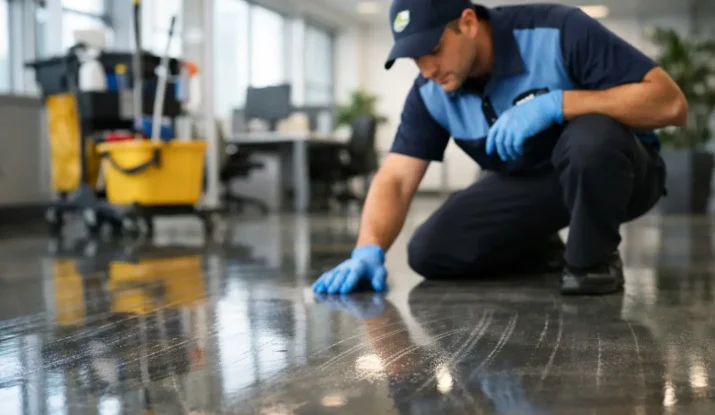
A freshly mopped lobby floor should make a facility look cared for. When overhead lights reveal cloudy lines, footprints, or dull mop marks instead, it can create the opposite impression. So, why do office floors streak after cleaning? In most cases, the issue is not a lack of effort. It is a mismatch between the floor surface, the cleaning product, the equipment, and the process used to remove soil and moisture.
For office managers and facility teams, streaking is more than a cosmetic concern. It can make an otherwise clean building feel neglected, lead to tenant or visitor complaints, and shorten the useful life of hard-floor finishes. Finding the cause is the first step toward a cleaner, more consistent result.
Why Do Office Floors Streak After Cleaning?
Streaks form when residue, loosened soil, or uneven moisture dries on the floor rather than being fully removed. Some streaks look like straight mop lines. Others appear as hazy patches, dark traffic paths, or a film that becomes especially visible in sunlight and under bright lobby lighting.
The exact cause depends on the flooring. Vinyl composition tile, luxury vinyl tile, ceramic tile, sealed concrete, terrazzo, and hardwood all have different cleaning needs. A method that works well on one material can leave another looking cloudy or damaged.
Too Much Cleaning Solution
Using extra cleaner does not necessarily produce a cleaner floor. In fact, over-concentrated neutral cleaner, degreaser, or disinfectant is one of the most common causes of streaking. The excess product dries into a thin film that attracts dust and shows up as lines or dull spots.
This often happens when cleaning staff estimate dilution rather than measuring it. It can also happen when a mop bucket is repeatedly topped off with product without being emptied and refreshed. Over time, the water becomes a mixture of cleaner, dissolved finish, and soil that is spread back across the floor.
Follow the product label and use a properly calibrated dilution system when possible. If a floor already has product buildup, a clean-water rinse may be necessary after the appropriate cleaning step. Some floors require a more specific restoration process, so aggressive chemicals should not be used as a shortcut.
Dirty Mops, Pads, or Water
A mop can look acceptable and still be carrying enough soil to leave visible marks. Once microfiber mop heads, string mops, auto-scrubber pads, or cleaning water become heavily soiled, they stop lifting dirt effectively. Instead, they redistribute it.
This is especially noticeable in entryways, break rooms, restrooms, and high-traffic corridors. Salt, slush, road grime, food residue, and moisture tracked in during Chicago-area weather can create a gray film that dries in streaks. A single mop head used from a dirty entrance through a lobby can transfer that soil across the entire space.
Color-coded microfiber tools, frequent mop changes, and separate tools for restrooms, food areas, and general office spaces help control cross-contamination and improve appearance. Clean water matters just as much. If the bucket water is dark or cloudy, it is time to replace it.
Incomplete Soil Removal Before Mopping
Mopping a floor before dry debris has been removed creates another common problem. Fine dust, paper fibers, sand, and grit mix with moisture and form a slurry. As the floor dries, that slurry can leave streaks and haze.
Vacuuming with high-filtration equipment or dust mopping before wet cleaning is particularly important near entrances and on smooth hard surfaces. This step also protects the floor. Sand and grit act like abrasives under shoes, gradually scratching finishes and making future streaking more visible.
Incorrect Equipment or Mop Technique
A heavily saturated mop leaves too much water behind. A dry or poorly maintained mop may skip across the surface and leave uneven lines. Both conditions can create streaks.
Technique matters as well. Overlapping passes help prevent missed sections, but repeatedly passing over partially dried areas can leave visible lap marks. Cleaning in manageable sections allows the team to maintain a wet edge and remove solution before it dries unevenly.
For larger offices, an auto scrubber with the right pad, solution flow, brush pressure, and recovery settings can provide more uniform results than manual mopping. However, an auto scrubber will also streak if its recovery squeegee is worn, its pads are dirty, or it is dispensing too much solution. The equipment needs inspection and maintenance, not just operation.
Worn or Uneven Floor Finish
Sometimes the cleaning process is correct, but the floor finish is the real issue. Old finish can become porous, scratched, yellowed, or unevenly layered. It holds soil in some areas while repelling cleaner in others, which makes the floor appear streaky even after routine service.
High-traffic lanes near elevators, reception desks, and break rooms often wear differently than the rest of the floor. Applying finish over embedded soil or skipping proper preparation can also trap contamination beneath new layers. The result may be a patchy sheen rather than a consistent appearance.
In this situation, changing the daily mop routine may help only temporarily. The floor may need professional scrub and recoat service, burnishing, or complete stripping and refinishing, depending on its material and condition. The right option balances appearance, budget, downtime, and the remaining integrity of the existing finish.
How to Identify the Source of Floor Streaks
A close look at where and when streaks appear can narrow down the cause. Lines that follow the path of the mop usually point to dirty tools, excess solution, or inconsistent technique. A cloudy film across a broad area often suggests product buildup. Dark marks around entrance paths may indicate that dry soil removal or matting is not keeping up with foot traffic.
If streaking appears only after the floor dries, inspect dilution ratios and whether the surface is being rinsed when required. If it appears immediately behind an auto scrubber, check the squeegee, recovery tank, pad condition, and machine settings. If the same dull areas remain after several properly performed cleanings, look at the floor finish rather than the daily cleaning crew.
Documenting the floor type, cleaning products, dilution ratios, equipment used, and affected areas can make troubleshooting faster. This is particularly useful in multi-tenant offices, health care settings, schools, and properties with several flooring materials.
A Better Routine for Streak-Free Office Floors
Consistent floor appearance comes from a controlled process, not simply mopping more often. Start by removing dry debris thoroughly. Use entry mats that are sized for the amount of foot traffic and maintain them regularly, since mats capture grit before it reaches hard flooring.
Next, select a product approved for the floor type and dilute it exactly as directed. Use clean microfiber pads or mop heads, change them before they become overloaded with soil, and replace dirty water frequently. Apply only enough solution to clean the surface, then allow the floor to dry without unnecessary foot traffic.
For high-visibility areas, schedule floor care around building activity. Early morning, evening, or low-occupancy periods can give the floor adequate drying time and reduce the chance that wet shoe traffic creates marks. Place wet-floor signs whenever needed to support safety and direct people away from the area.
Routine maintenance should also include periodic deep cleaning. A daily cleaning program cannot correct every problem caused by months of tracked-in soil, damaged finish, or improper prior care. Planned specialty service prevents minor haze from becoming a more expensive restoration project.
When Professional Floor Care Is the Right Call
Facility teams can solve many streaking issues by improving product dilution, tool changes, and cleaning sequence. Professional support becomes valuable when streaks persist despite those corrections, when floors have visible finish damage, or when a large facility needs a more consistent standard across multiple areas.
A qualified commercial floor-care team can assess the flooring material, identify buildup or finish failure, and recommend a process that fits the property. That may involve deep scrubbing, machine cleaning, burnishing, recoat work, or stripping and refinishing. The goal is not to use the most aggressive method. It is to use the method that safely restores a uniform, clean appearance while protecting the floor asset.
ABF Facility Services helps Chicagoland facilities coordinate routine janitorial work with specialized hard-floor care, using trained, insured, OSHA-compliant teams and equipment suited to the task. A single accountable provider can also help keep cleaning products, mats, and related supplies aligned with the actual needs of the building.
A streak-free floor should not depend on luck or last-minute touch-ups before a visitor arrives. With the right tools, measured products, clean water, and a maintenance plan matched to the surface, office floors can stay clear, professional, and ready for the people who use them every day.