
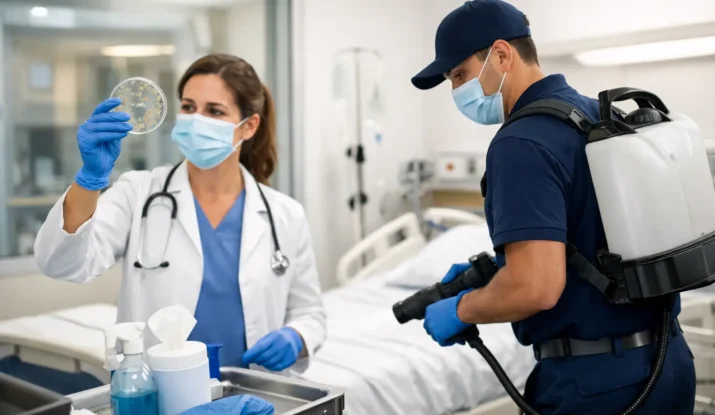
A hospital infection control case study is most useful when it shows what happened between policy and practice. Written procedures may define how patient rooms, restrooms, waiting areas, and high-touch surfaces should be cleaned. The real test is whether those tasks happen consistently, with the right products, dwell times, documentation, and supervision on every shift.
The following composite case reflects common operational challenges faced by healthcare facility leaders. It is not a claim about one specific hospital. Instead, it illustrates how a focused environmental cleaning program can strengthen infection-prevention efforts while improving accountability across a busy facility.
The Situation: Good Standards, Uneven Execution
A mid-sized hospital had established cleaning protocols and a committed environmental services team. Yet leadership was receiving inconsistent feedback from nursing units, patient experience staff, and maintenance supervisors. Some areas looked clean, while others had missed trash removal, depleted hand-hygiene supplies, or visible soil on high-touch surfaces during peak visiting hours.
The concern was not simply appearance. In a hospital, the condition of the environment affects patient confidence, staff workflow, and infection-prevention strategy. Cleaning is one layer of a broader system that includes hand hygiene, clinical practices, air quality, waste handling, and isolation precautions. When that layer is inconsistent, it can create unnecessary risk and make it harder for infection prevention leaders to identify where breakdowns are occurring.
The hospital’s challenge was especially clear during shift changes and high-census periods. Rooms turned over quickly, public restrooms saw heavy use, and cleaning staff often had to respond to urgent requests without losing track of scheduled work. The existing program relied heavily on visual inspections, which could not always confirm that high-touch surfaces had been cleaned correctly.
What the Hospital Infection Control Case Study Found
An initial walkthrough and workflow review identified three issues that required attention: unclear cleaning ownership at transition points, unreliable supply visibility, and limited performance verification.
Missed tasks occurred at handoff points
The team found that a patient room might be serviced by more than one person during a day. A daily cleaner, a turnover team member, and a staff member responding to a spill or urgent request could all enter the same space. Without a clear handoff process, some tasks were duplicated while others were assumed to be complete.
High-touch surfaces were the most vulnerable. Bed rails, call buttons, light switches, door handles, restroom fixtures, and waiting-room armrests are easy to overlook when a team is moving quickly. The issue was not a lack of effort. It was a workflow design problem.
Supplies were stocked inconsistently
Hand soap, paper products, gloves, liners, disinfectant wipes, and sanitizer dispensers were managed through separate routines. A cleaner could complete the assigned work properly but still leave a unit short on a critical consumable because replenishment was handled by another process.
For facility leaders, this creates an avoidable service gap. A clean restroom without soap is not ready for use. A patient area without gloves or properly placed liners can slow staff down and lead to workarounds that should never be necessary.
Visual checks were not enough
Supervisors performed regular rounds, but the audit process varied by shift and by department. One supervisor might focus on floors and restrooms, while another concentrated on trash, odors, and visible dust. Those checks mattered, but they did not consistently measure whether defined high-touch cleaning steps were completed.
The hospital needed a repeatable inspection method with clear standards, documented findings, and fast corrective action. Without that structure, leadership could identify a problem but struggled to see patterns over time.
Building a More Controlled Cleaning Process
The response began with one practical decision: organize work by risk and function, not just by square footage. A lobby, a staff break room, an exam space, and an isolation room do not have the same traffic, exposure profile, or cleaning requirements. Treating them alike can waste labor in low-risk areas and leave too little time for critical tasks.
Clear zones and color-coded tools
The facility divided spaces into defined cleaning zones, with written task cards for each. Public areas, patient-care spaces, restrooms, staff areas, and waste-handling points each had specific service expectations. Color-coded microfiber cloths and mop systems helped reduce the chance that tools used in one type of area would be carried into another.
This is a simple control, but it depends on training and supervision. Color coding only works when teams know the system, replacement tools are available, and used materials are collected and laundered or disposed of properly.
The cleaning sequence was also standardized. Staff moved from cleaner areas toward more heavily soiled areas and from higher surfaces toward floors. High-touch surfaces were addressed at defined intervals, not only when they looked dirty. That distinction matters because many contaminated surfaces show no visible sign of use.
Product selection and contact time
The hospital reviewed disinfectant use with its infection-prevention and environmental services leaders. Teams were trained to use products appropriate for the surfaces and the facility’s protocols, follow manufacturer instructions, and allow required contact time before wiping or allowing the surface to dry.
There is a trade-off here. Stronger chemistry is not automatically better for every task. Some products can affect sensitive finishes, create unpleasant odors, or require additional safety precautions. The right approach considers the organism concerns identified by the facility, surface compatibility, staff safety, ventilation, and the exact label directions.
Training also addressed a common error: spraying and immediately wiping a surface dry. Disinfection requires more than product application. The surface must remain wet for the required period, which means staffing plans need to allow enough time to perform the task correctly.
Turnover cleaning with defined release criteria
Patient-room turnover became a controlled process rather than an informal checklist. The cleaner documented completion of high-touch surfaces, restroom cleaning, waste removal, linen handling, floor care, and supply reset. A supervisor performed spot checks on a rotating basis, with additional review for rooms requiring enhanced precautions.
The room was not treated as ready based on speed alone. It had to meet the facility’s release criteria. This reduced confusion between nursing, transport, environmental services, and admissions teams, especially during busy periods.
Verification Made the Difference
The most meaningful change was not adding more tasks. It was making performance visible. Supervisors used consistent inspection forms, and results were reviewed by location, shift, and task category. Rather than reporting a general cleanliness score, the hospital tracked whether high-touch surfaces, restroom fixtures, waste points, floors, and supply stations met the defined standard.
When a miss was found, the response was immediate. The area was corrected, the cause was documented, and the supervisor looked for similar risks nearby. If several misses involved the same task, the team reviewed the procedure instead of treating every finding as an individual performance failure.
This approach produced better conversations. A recurring issue with empty dispensers, for example, could be traced to supply-par levels, delivery timing, unclear responsibility, or a damaged unit. The solution depended on the cause. Blaming a cleaner for a system problem would not prevent the next shortage.
Results That Matter to Facility Leadership
Within the first review cycle, the hospital saw fewer service complaints related to restrooms, trash, and room readiness. More importantly, leaders had clearer evidence of what was being completed and where additional coaching was required. The program improved operational control, not just the appearance of cleanliness.
It would be inaccurate to credit environmental cleaning alone for changes in healthcare-associated infection outcomes. Infection prevention is multidisciplinary, and many variables affect results. However, reliable cleaning and disinfection reduce one important source of environmental risk and support the work of clinical teams.
The case also reinforced the value of integrating cleaning with supply management. Restroom products, gloves, liners, paper goods, and floor-care materials should not be treated as separate afterthoughts. When one accountable partner monitors both service and replenishment, facility managers spend less time chasing shortages and resolving preventable complaints.
Lessons for Chicago-Area Hospitals and Medical Facilities
Hospitals and medical facilities in Chicago and the surrounding suburbs operate under constant pressure to maintain safety, readiness, and patient confidence. A cleaning program should be judged by more than whether a corridor looks polished at the end of the day. It should show clear task ownership, trained personnel, proper tools, dependable supply levels, and a process for verifying results.
For some facilities, an in-house team with stronger auditing and supply controls may be the right answer. For others, an experienced facility-services partner can provide additional staffing flexibility, specialty floor care, disinfection support, high-filtration vacuuming, and recurring consumable management. The best choice depends on the facility’s size, acuity, internal resources, and existing infection-prevention program.
ABF Facility Services approaches healthcare-adjacent cleaning work with trained, uniformed, insured, OSHA-compliant teams, color-coded systems, microfiber tools, and a focus on consistent execution. Every facility should still define its own clinical protocols and cleaning priorities in coordination with its infection-prevention leadership.
A clean hospital environment is built through hundreds of small, repeatable actions. When each action has an owner, a standard, and a way to verify completion, facility leaders can spend less time reacting to missed details and more time supporting safe, welcoming care environments.