
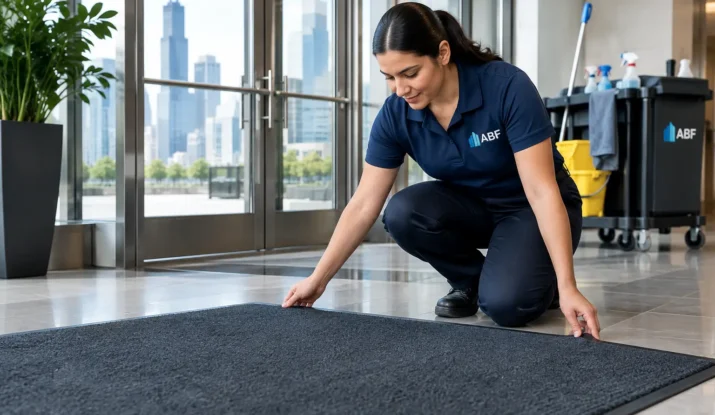
Chicago weather does not stay outside. Rain, slush, road salt, mud, and windblown debris come through every entrance and quickly spread across lobbies, corridors, sales floors, and work areas. The best floor mats Chicago businesses can use are not simply mats that look presentable on day one. They are commercial-grade systems chosen for the traffic, flooring, entry layout, and safety requirements of the facility.
For a property manager or operations leader, floor mats are a practical first line of defense. The right matting program helps reduce slip hazards, protects hard floors and carpet, improves first impressions, and cuts down on the labor required to keep entrances clean. The wrong one can curl at the edges, become saturated, track moisture farther into the building, or create a cluttered appearance that reflects poorly on the property.
What Makes the Best Floor Mats in Chicago?
The best choice depends on what happens at your door. A busy downtown office, a healthcare waiting area, a restaurant kitchen, and an industrial loading entrance do not have the same needs. A reliable floor mat program starts with an honest assessment of foot traffic, weather exposure, flooring type, and the people using the space.
In Chicagoland, moisture control matters for much of the year. An entry mat needs enough surface area and absorbency to capture water before it reaches smooth hard flooring. It also needs a stable backing that stays in place under repeated traffic. For facilities with tile, stone, polished concrete, luxury vinyl, or sealed wood surfaces, that stability is directly connected to occupant safety.
Appearance matters too. Clean, well-maintained mats frame an entrance and make a facility feel organized from the moment someone walks in. That is especially valuable in offices, retail locations, schools, hospitality properties, medical settings, and multi-tenant buildings where visitors form opinions quickly.
Prioritize performance before color
A mat color should complement the property, but color is not the primary buying decision. Darker patterned mats can hide routine soil between service visits, while branded mats can reinforce a professional entrance. Still, a mat that looks good but does not capture moisture or stay flat is not doing its job.
Focus first on the pile material, backing, edge construction, and size. Then select the color, pattern, or logo treatment that fits your facility. This order helps prevent a common mistake: choosing a decorative mat that is too small or too light-duty for the entrance.
Start With the Entrance, Not the Catalog
A floor mat program works best when it follows the path people take into the building. Rather than placing one small mat immediately inside the door, consider the full transition from outside conditions to interior flooring.
At a primary entrance, outdoor scraper mats remove larger debris from shoes. Interior wiper mats then absorb moisture and fine soil. In high-traffic buildings, longer walk-off coverage is usually more effective than a single short mat because visitors need multiple steps to remove water from footwear. A compact mat may be adequate for a low-use side door, but it will be overwhelmed at a busy employee entrance during a Chicago snow event.
Door swing, vestibule dimensions, accessibility clearances, and emergency egress all need to be considered. A mat should lie flat, avoid obstructing doors, and fit the available space without becoming a trip risk. This is why measurement and site assessment are more valuable than selecting a standard size based only on price.
Match mat types to the work area
Different areas require different protection. Entryway mats are designed for dirt and moisture control, while interior locations may need anti-fatigue, anti-slip, or specialty logo mats.
Anti-fatigue mats can be useful where employees stand for long periods, such as reception desks, production stations, packing areas, service counters, and kitchen work zones. They can improve comfort, but they must be chosen carefully for the environment. In wet or greasy areas, a mat needs drainage and slip-resistant features appropriate for the surface and task. In industrial environments, chemical exposure, oils, welding debris, and equipment traffic may require heavier-duty materials than those used in an office lobby.
Restaurant and food-service operators should also consider mats around dishwashing stations, prep areas, bar service areas, and rear entrances. These mats must support safer footing while remaining manageable for routine cleaning or scheduled exchange. A mat that traps grease and moisture without proper maintenance can create more problems than it solves.
Rental, Purchase, or Managed Service?
Facilities often ask whether they should buy mats or use a rental and exchange program. There is no single answer. The right approach depends on the number of locations, traffic volume, staffing capacity, storage space, and standards for cleanliness and presentation.
Buying may make sense for a low-traffic area with a stable environment and an internal team that can clean, dry, inspect, and replace mats as needed. However, ownership also means the facility is responsible for laundering, stain removal, odor control, storage, replacement, and monitoring worn edges or deteriorating backing.
A managed rental program is often a better operational fit for entrances and high-use spaces. Mats are delivered, exchanged on a set schedule, and removed for professional laundering. That gives facility teams a consistent rotation of clean mats without asking janitorial staff to manage bulky, waterlogged inventory on site.
Service frequency should change with conditions. A weekly exchange may be suitable for a busy entrance during winter or rainy periods, while other areas may perform well on a different schedule. The key is not choosing the lowest frequency on paper. It is selecting a service interval that keeps mats effective, presentable, and safe during actual use.
Protect Floors Beyond the Front Door
Floor mats are part of floor care, not a substitute for it. Their role is to reduce the amount of grit, salt, and moisture that reaches the floor. When matting is paired with routine vacuuming, mopping, carpet care, and hard-floor maintenance, facilities can reduce visible wear and protect finishes longer.
Road salt is a particular concern in Chicago. Once tracked indoors, it can leave white residue, dull floor finishes, and contribute to surface damage over time. Fine grit can also act like sandpaper under shoes and rolling traffic, scratching hard floors and grinding into carpet fibers. Effective mats capture much of that material at the door, where it can be removed before it travels through the building.
For multi-tenant properties, consider secondary matting at elevator banks, garage entrances, and interior corridors during severe weather. For warehouses and industrial sites, place suitable mats at office-to-production transitions, employee entrances, and areas where outdoor debris enters from loading activity. These are targeted decisions that can make a noticeable difference in cleaning workload and floor appearance.
Questions to Ask Before Choosing a Mat Provider
A dependable provider should be able to recommend more than a mat style. They should ask about traffic patterns, flooring, site conditions, seasonal needs, and service expectations. Their program should make it clear who is responsible for delivery, exchange, cleaning, replacements, and responsiveness when needs change.
Ask whether the mats have non-slip backing, reinforced edges, and appropriate materials for your environment. Confirm how often mats will be serviced and whether the schedule can be adjusted during winter weather or periods of unusually heavy traffic. If you need logo mats, clarify how artwork approval, production timing, replacement, and cleaning are handled.
It is also reasonable to ask how damaged, curled, or heavily stained mats are addressed. A floor mat program should not leave a facility waiting for a solution when an entrance mat becomes a safety concern. Reliable service means the provider notices details and responds before a small issue becomes a tenant complaint, inspection concern, or avoidable incident.
A Better Fit for One-Provider Facility Care
Floor mats are easy to overlook because they are underfoot. Yet they affect safety, cleaning efficiency, floor longevity, and the first impression of nearly every building. When mats, recurring cleaning, restroom supplies, and floor care are managed separately, the details can fall between vendors.
ABF Facility Services helps commercial and industrial facilities coordinate floor mat rental and supply needs alongside janitorial service, hard-floor care, consumables, and other ongoing facility requirements. That one-provider approach gives building teams a clearer point of accountability and makes it easier to align mat service with seasonal conditions and actual cleaning demands.
The best mat program is the one that fits the way your facility operates, not the one that looks cheapest in a catalog. Walk your entrances after the next wet day, look at where water and debris travel, and use what you find to set a matting plan that keeps people safer and floors ready for business.