
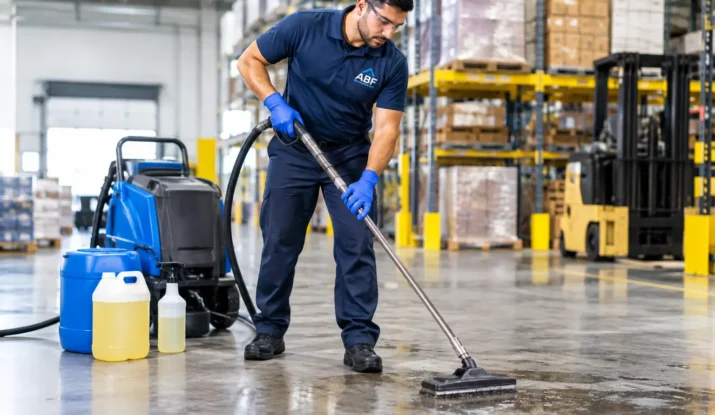
A warehouse floor can look clean at the start of a shift and still create a slip hazard by noon. Forklift traffic spreads hydraulic fluid, dock areas collect tire marks and diesel residue, and maintenance zones accumulate lubricants that ordinary floor cleaner will not remove. Choosing the best industrial degreasers for warehouses is less about finding the strongest chemical and more about selecting a product and process that remove the specific soil without damaging floors, disrupting operations, or creating a disposal problem.
What Makes a Degreaser Right for Warehouse Use?
Industrial degreasers are designed to break the bond between oily soil and a surface so the contamination can be lifted, rinsed, or extracted. Warehouse facilities need more than cleaning power. The right product must also suit the flooring material, the type of equipment in use, the availability of drainage, and the safety expectations for employees and visitors.
A concentrated, high-alkaline degreaser may cut through old grease quickly, but it can dull finished concrete, affect painted surfaces, or leave residue if it is not diluted and rinsed correctly. A milder neutral or low-odor formula may be a better daily choice for an active distribution center, even if a stronger product is reserved for periodic deep cleaning.
The best choice depends on the soil. Petroleum-based oils, food-grade fats, rubber transfer, adhesive residue, and forklift battery acid each call for a different approach. Using one general-purpose product everywhere often leads to wasted labor, repeat cleaning, and floors that still look uneven.
Best Industrial Degreasers for Warehouses by Cleaning Need
Water-Based Alkaline Degreasers for General Floor Soil
Water-based alkaline degreasers are often the most practical option for warehouse floors, loading docks, maintenance bays, and equipment staging areas. They work by emulsifying oils and grease so the residue can be removed with an automatic scrubber, mop system, or controlled rinse.
For many facilities, this category provides the best balance of cleaning performance and day-to-day usability. Select a product with a dilution range that matches the job. Light traffic film may only require a low-concentration solution, while tire marks and heavy lubricant buildup may need a stronger mix and additional dwell time.
The trade-off is that highly alkaline products can be too aggressive for certain sealed floors, painted lines, aluminum fixtures, or sensitive finishes. Always confirm surface compatibility before putting a new chemical into regular use.
Solvent-Based Degreasers for Heavy Petroleum Buildup
Solvent-based products are useful when water-based formulas cannot penetrate thick petroleum grease, waxy grime, or sticky residue. Maintenance shops, equipment repair areas, and older dock floors with neglected buildup may benefit from a targeted solvent degreaser.
These products should be handled carefully. Strong odors, flammability concerns, ventilation needs, and worker exposure requirements can make them impractical for broad daily use. They are usually best applied as a spot-treatment tool by trained personnel rather than used across an entire warehouse floor.
If a solvent product is necessary, isolate the work area, use appropriate personal protective equipment, and verify that rags, pads, and recovered waste are managed correctly. The fastest chemical solution is not a good value if it creates avoidable safety or disposal issues.
Enzyme and Bio-Based Degreasers for Ongoing Maintenance
Bio-based and enzyme-supported degreasers can be a good fit for facilities seeking lower-odor products and more environmentally considerate cleaning programs. These formulas are commonly used for recurring cleanup in food storage areas, break rooms, light manufacturing spaces, and places where employees work near the cleaning activity.
They can be effective on organic oils, food fats, and everyday buildup, especially when used consistently. However, they may not act as quickly on thick industrial lubricants or deeply embedded petroleum soils. For a facility with mixed conditions, a bio-based product may be ideal for scheduled maintenance while a heavier-duty degreaser is held for spills and specialty projects.
Non-Corrosive Degreasers for Sensitive Surfaces
Warehouses contain more than concrete. Metal shelving, loading equipment, machine guards, painted surfaces, electrical enclosures, and polished flooring may all need attention. Non-corrosive degreasers are designed to reduce the risk of etching, discoloration, or chemical damage on these surfaces.
They are particularly valuable when crews clean around conveyors, racking systems, or equipment that cannot be rinsed freely. A less aggressive formula may require more mechanical action, such as microfiber wiping or agitation with a scrub pad, but that extra step is preferable to damaging facility assets.
Match the Product to the Floor Before Ordering
Concrete is durable, but it is not indestructible. Unsealed concrete can absorb oils and cleaning chemicals, while sealed or polished concrete can lose its appearance if the wrong degreaser, pad, or dilution is used. Epoxy coatings and safety striping also need surface-specific care.
Before committing to a degreaser, test it in a small, inconspicuous area. Check for changes in color, gloss, coating adhesion, or traction after the area dries. This simple test can prevent a costly floor restoration project.
For polished concrete, neutral or manufacturer-approved products are often the safest starting point. For sealed concrete or epoxy, use a compatible degreaser and avoid allowing concentrated solution to sit longer than necessary. In older, unsealed concrete, the main challenge may be extraction. The cleaner can loosen the oil, but a floor scrubber with proper recovery is needed to remove it instead of spreading it into the pores.
The Cleaning Process Matters as Much as the Chemical
Even the best industrial degreaser will underperform if it is applied without enough dwell time or removed with dirty water. Warehouse cleaning should follow a controlled process that keeps soil from being redistributed.
Start by dry sweeping or vacuuming dust, pallet debris, and loose material. Apply the diluted degreaser to the affected area and allow the recommended dwell time. Do not let the solution dry on the floor. Agitate heavy soil with the correct brush or scrub pad, then recover the solution using an automatic scrubber or wet vacuum. A clean-water rinse may be needed where residue could affect traction or leave a film.
For active docks and production areas, schedule heavier cleaning during low-traffic periods. Place clear wet-floor signage and reopen the area only after the surface is dry and safe to walk or drive on. Color-coded tools and dedicated equipment also help prevent oily soils from being carried into office areas, restrooms, or customer-facing spaces.
Safety, Ventilation, and Wastewater Need a Plan
Chemical selection should always be part of a broader safety plan. Review the product’s Safety Data Sheet, required personal protective equipment, ventilation guidance, first-aid measures, and storage instructions. Train employees on correct dilution rather than relying on guesswork. Overconcentrating a degreaser does not always improve results, and it can increase residue, cost, and surface risk.
Wastewater is another frequent concern. Grease-laden recovery water should not automatically be sent into a storm drain or exterior catch basin. Local requirements, facility drainage design, and the type of contaminant all affect how wastewater should be handled. When cleaning is performed around vehicle maintenance, machinery, or loading areas, a professional assessment can help prevent environmental compliance issues.
Build a Practical Warehouse Degreasing Program
A reliable program separates daily soil control from deep-restoration work. Daily or weekly scrubber cleaning keeps light oils and tire film from becoming embedded. Spill response procedures address fresh leaks immediately. Periodic detail cleaning focuses on dock edges, racking bases, maintenance areas, corners, and zones where equipment turns repeatedly.
Track where grease returns most often. Repeated buildup near one dock door or forklift lane may indicate an equipment leak, poor entry matting, or a traffic pattern that needs attention. Cleaning resolves the visible condition, but identifying the source protects the floor and reduces future labor.
For Chicago-area warehouses that need trained support for floor degreasing, pressure washing, industrial cleaning, and recurring consumable supply, ABF Facility Services can tailor a plan around operating hours, flooring, safety needs, and facility traffic. The goal is not simply a cleaner-looking floor. It is a safer, more dependable work environment that stays ready for the next shift.
Choose a degreaser that fits your soils and surfaces, then give it the correct equipment, dwell time, and recovery process. That combination will protect your floors far better than relying on the strongest product on the shelf.